


Understanding a government organization is hard for every startup and every innovator, in France or anywhere else. Who decides? Who funds? Whom do you call? And France has just reorganized how its government runs digital health. So, it’s time for an update.
Since September 2026, a new directorate-general in the Ministry of Health, the DGRINES, brings research, innovation and digital health under one roof. At the same time, the national health data platform is leaving Microsoft for a French sovereign cloud, and the 2023-2027 digital health roadmap enters its final year. Yet much of what you will find in English on the web still describes the previous setup. This article shows the updated map.
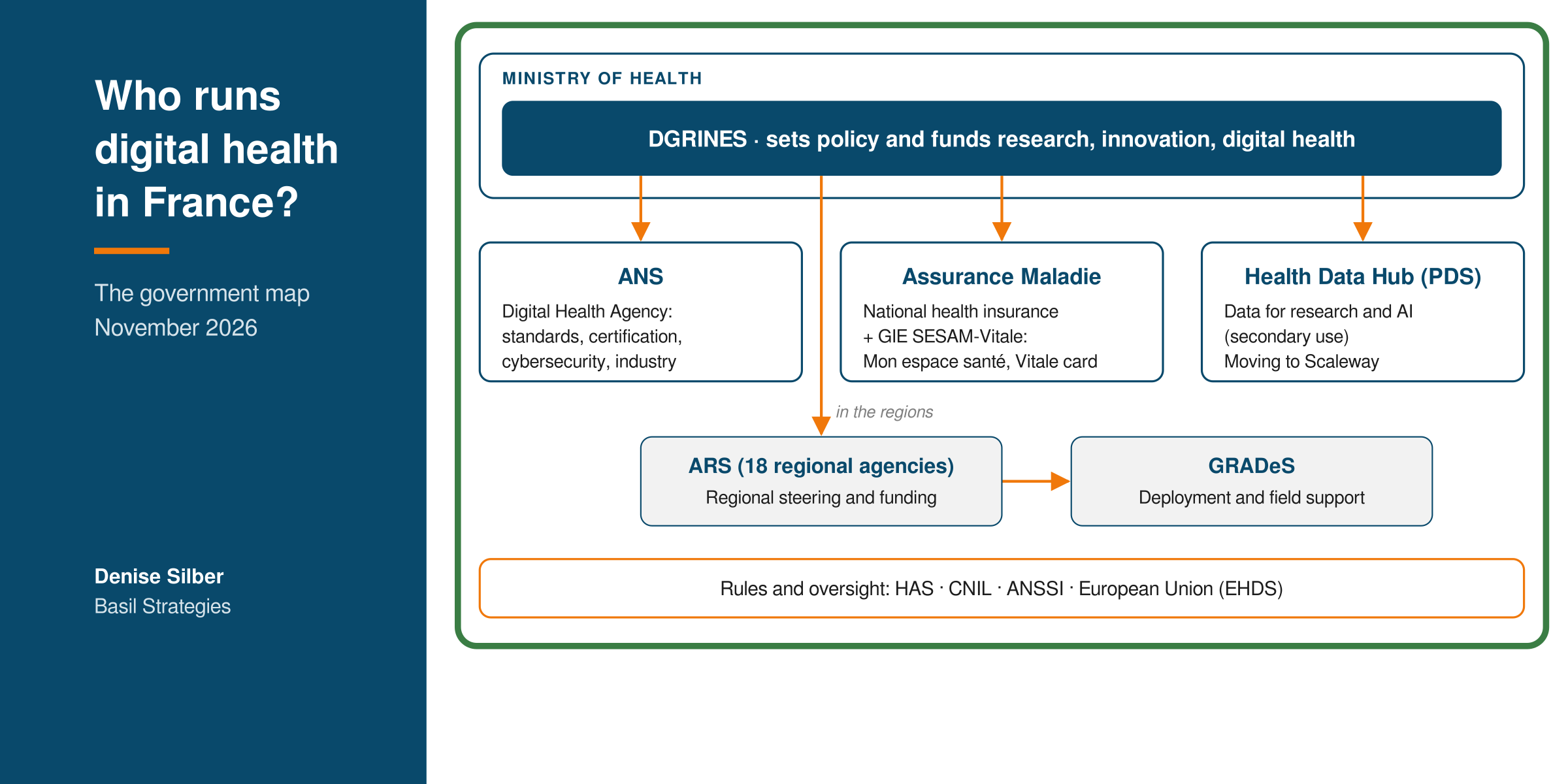
Each body has a distinct, complementary role. The Ministry, through the DGRINES, sets policy, writes the rules and funds the major programs. The national operators build and run the services that are the same across the country. In the regions, the ARS and the GRADeS help hospitals and health professionals adopt them.
At the top: the DGRINES, one directorate for research, innovation and digital health
The DGRINES (Direction générale de la recherche, de l’innovation et du numérique en santé) is a new directorate-general of the French Ministry of Health. Health Minister Stéphanie Rist announced it in December 2025. It was created by decree in summer 2026 and took shape between September and November 2026.
Its purpose is to bring greater clarity. These responsibilities used to be spread across several bodies: the Digital Health Delegation (DNS, created in 2019), two other ministry directorates (public health and hospital care), the Health Innovation Agency (AIS) and the “Article 51” program for innovative care models.
- Head: Lise Alter, a medical doctor, formerly chief of staff to the Health Minister and head of the Health Innovation Agency from 2022 to late 2024. David Sainati, who was interim head of the Digital Health Delegation (DNS) and then of the DGRINES until her arrival, is expected to become her deputy.
- Four sub-directorates. According to the draft organization chart reported by TICpharma in September, the expected leaders are:
- Innovation acceleration: Aymeric Perchant (formerly DNS), with Julie Gaillot (“Article 51”) as deputy
- Research and technology transfer: Julie Lagrave (currently sub-director for research and innovation at the Ministry of Health), with Vincent Vauchel as deputy
- Care transformation and pathways: Claire Vigier (formerly DNS), with Benjamin Luciani as deputy
- Digital resilience and trust: Xavier Vitry (formerly DNS), with Jean-Baptiste Milone as deputy
- A “federated one-stop shop”: a dedicated unit is meant to give project leaders a single, coordinated point of contact, with a regional network.
For anyone dealing with the French state on health innovation, this means research, data, AI and digital tools now come under one directorate.
The national operators: who builds and runs the services
The Digital Health Agency (ANS, Agence du numérique en santé) is the state’s technical arm. It writes the interoperability and security standards, certifies software and runs the dialogue with industry. By April 2026, for example, it had certified 51 remote patient monitoring solutions. Jean-Christophe Zerbini has led it since December 2025.
The national health insurance fund (Assurance Maladie) and the GIE SESAM-Vitale, which runs the Vitale health card, operate the everyday services. The flagship is Mon espace santé, the national patient health record and portal. In early 2026, 97% of the population had a profile and over 24 million people had activated it, more than one in three. The target is 40 million by the end of 2027. Health professionals uploaded 450 million documents in twelve months.
The Health Data Platform (PDS, better known as the Health Data Hub) handles secondary use of data: research, evaluation and AI. Created in 2019 and hosted on Microsoft Azure, it was never able to host the main national claims database (SNDS). In April 2026 it chose Scaleway, a French provider with SecNumCloud security certification, as French law now requires. Migration is planned between late 2026 and early 2027.
The plan: a roadmap and a technical doctrine
The 2023-2027 digital health roadmap sets 65 objectives around four themes: prevention, giving time back to clinicians, access to care and a framework that supports innovation. Progress is published every six months. At mid-term, in June 2025, over 75% of the objectives were more than half achieved.
The 2026 digital health doctrine, published in March, is the technical rulebook. It contains 35 thematic sheets covering interoperability, cybersecurity, electronic identification, AI ethics and the European Health Data Space (EHDS) regulation.
The “Ségur numérique” program pays software vendors to upgrade their products so they can feed Mon espace santé and secure messaging. On the innovation side, France 2030’s digital health acceleration strategy had committed €570 million by May 2026.
In the regions: the ARS and the GRADeS
France has 18 regional health agencies (ARS, Agences régionales de santé), which steer and fund health policy in each region. Each one works with a regional digital health operator, the GRADeS, which deploys services and supports hospitals, care homes and health professionals on the ground. The Assurance Maladie is also present locally through its network of local funds.
The region is often the most practical entry point for a pilot or a first deployment.
The rule-setters
Other public bodies set the rules without running the roadmap:
- The HAS (Haute Autorité de santé), the national health technology assessment body, evaluates digital medical devices and AI, and includes digital and cybersecurity criteria in hospital accreditation.
- The CNIL, the data protection authority, oversees the use of health data, especially for research.
- The ANSSI, the national cybersecurity agency, awards the SecNumCloud certification, now mandatory for hosting the state’s sensitive data.
- The European Union, through the European Health Data Space regulation published in March 2025, frames both the care and the research uses of health data.
Will it be easier? What to watch in 2027
France now brings research, innovation and digital health together in one directorate, with a single point of contact. Will it make life easier for innovators? Only time will tell. In 2027 I will be watching the first steps of the DGRINES and its one-stop shop, the Health Data Hub’s move to Scaleway, the 40-million target for Mon espace santé, the rollout of the European Health Data Space and the preparation of the next roadmap.
Sources
- Le ministère de la Santé rationalise le pilotage du numérique et de l’innovation, Acteurs publics, November 2026 (in French)
- TICpharma/APMnews, September 11, 2026, on the DGRINES organization chart (in French)
- 2026 digital health doctrine, ANS (in French)
- Mon espace santé: status and outlook, March 2026, ANS (in French)
- The Health Data Platform begins its migration to Scaleway, PDS press release, April 23, 2026 (in French)